


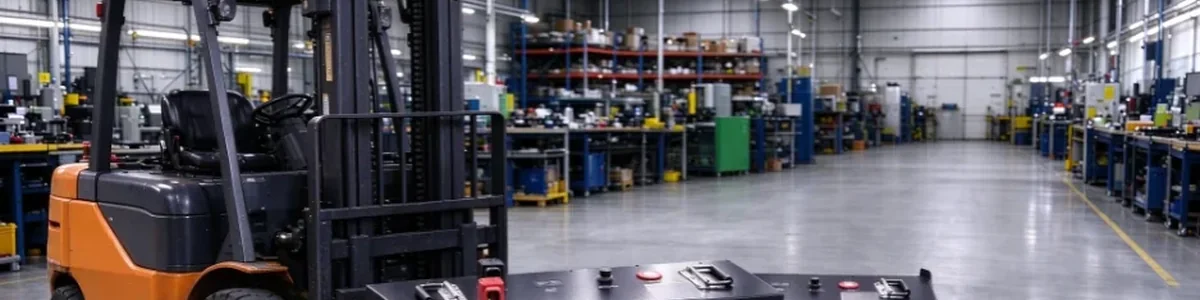
An aerial platform is a battery with a lift attached: the machine sits idle, then draws hard while the motor runs, then sits again. Deep discharge and long idle are both harder on lead-acid than on sodium.
What the machines use
| Class | Voltage | Original | Typical pack |
|---|---|---|---|
| Vertical mast lift | 24 V | 2 × 12 V or 4 × 6 V | 24 V 100–200 Ah |
| Scissor lift, 8–12 m | 24 V / 48 V | 4 × 6 V or 4 × 12 V | 48 V 150–300 Ah |
| Boom lift | 48 V / 80 V | Traction cells in steel tray | Custom |
Common brands: JLG, Genie, Skyjack, Haulotte, Manitou, Dingli, Sinoboom. Counterweight matters more here than in most swaps — a lighter pack changes the machine’s stability envelope, so the tray needs ballast or the manufacturer’s approval.
How to size the pack
1. Duty per shift. A scissor lift in a warehouse uses 10–25 kWh over a shift including travel and lift cycles.
2. Usable depth. Divide by 0.8. Platforms discharge deeply and are often returned at low charge.
3. Peak draw. Lifting and driving together is the peak. Check the continuous rating against it, not against the average.
Why sodium fits this duty
Platforms discharge deeply and then sit for days. Sodium tolerates both without the sulphation that takes capacity out of a lead-acid set, and it does not need heating to be ready in a cold yard.
What to check first
Voltage, tray dimensions, connector type and whether the machine’s controller reads state of charge from the battery. On many lifts the gauge drives a cut-out at low charge, so a pack that reports differently will stop the machine early.
Where it is not worth it
A hire fleet with a charger room. Scheduled lead-acid replacement and on-site charging make the change a project rather than a purchase.
A platform with no ballast space. Stability is the manufacturer’s call, and guessing is not an option.
Questions buyers ask
Will the machine’s low-charge cut-out work?
Only if it reads charge correctly. Most lifts take a voltage signal; a sodium pack needs either a matched gauge or a controller setting.
Can it sit outside in winter?
Yes for discharge. Charging needs the pack above its floor, so charge indoors or accept a reduced rate.
Do I need to change the charger?
Usually yes, or reprogram it. A lead-acid profile will undercharge the pack.
How much weight do I save?
Often 40–60% of the original set, which is why ballast becomes part of the job.