Price on request — quoted per configuration, quantity and Incoterm.Ask for a price →
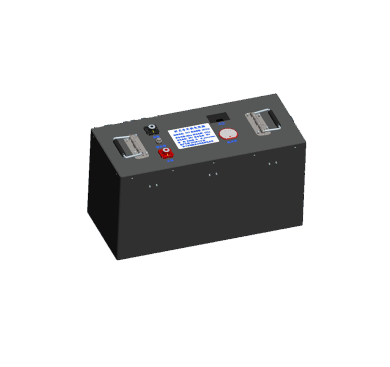
A 24 V 160 Ah sodium-ion traction battery for electric forklifts and warehouse trucks. Sodium-ion cells, a 9S configuration and IP66 sealing in a 60 kg case that drops into the compartment the lead-acid block came out of.
Why sodium-ion on a forklift
−40 to +65 °C discharge. Works in a cold store and on a summer dock without a heated battery room.
Power when it is loaded. 30 kW for one second, 500 A peak for one second, 300 A for ten — the lift and the drive motor both get what they ask for.
4,000 cycles at 80% DoD. More than eight years of daily shifts, so the pack outlives the truck lease.
No watering, no acid. No topping up, no equalisation charge and no acid spill in the aisle.
Low self-discharge. A truck parked over a shutdown does not come back to a flat pack.
Drop-in. Same 24 V class and terminal arrangement as the lead-acid block; the BMS is inside the case.
Specification
Model: 24V160Ah
Form: Traction pack for industrial vehicles
Chemistry: Sodium-ion (Na-ion)
Nominal voltage: 25.6 V
Nominal capacity: 160 Ah
Minimum capacity: ≥155 Ah
Rated energy: 4,100 Wh
Operating voltage range: 18.0–31.0 V
Maximum discharge power (1 s): 30,000 W
Fast-charge voltage: 31.0 ±0.2 V
Float charge voltage: 29.0–29.6 V
Low-voltage cut-off: 18.0–21.0 V
Standard charge current: 80 A
Recommended charge current: ≤160 A
Maximum charge current: 160 A
Standard discharge current: 50 A
Recommended discharge current: ≤160 A
Peak discharge current (10 s): 300 A
Peak discharge current (1 s): 500 A
Internal resistance: ≤10 mΩ
Charge temperature: −10 to +55 °C
Discharge temperature: −40 to +65 °C
Cycle life: >4,000 cycles (25 °C, 0.5C, 80% DoD)
Cell configuration: 9S
IP grade: IP66
Weight: ≈60.0 kg
Dimensions: 550 × 240 × 265 mm
Packing dimensions: 600 × 290 × 340 mm
BMS: Built in — state monitoring, fault protection, communication; 4G optional
Bluetooth: Supported
Application: Electric forklifts, warehouse trucks, industrial vehicles
SOC and OCV
25 °C discharge, 0.5P
25 °C charge, 0.5P
SOC
OCV (V)
SOC
OCV (V)
100%
29.09
0%
18.53
90%
28.49
10%
22.56
80%
28.38
20%
24.73
70%
28.04
30%
25.66
60%
27.58
40%
26.71
50%
27.17
50%
27.54
40%
26.58
60%
27.75
30%
25.58
70%
28.20
20%
24.58
80%
28.53
10%
22.32
90%
28.63
0%
18.65
100%
29.60
Scope
Supplied assembled and tested, with the BMS set for the charger already on site. Tell us the truck model and the charger voltage and we will confirm the connector and the cut-off before dispatch.
Form
Traction pack for industrial vehicles
Chemistry
Sodium-ion (Na-ion)
Nominal voltage
25.6 V
Nominal capacity
160 Ah
Minimum capacity
≥155 Ah
Rated energy
4,100 Wh
Operating voltage range
18.0–31.0 V
Maximum discharge power (1 s)
30,000 W
Fast-charge voltage
31.0 ±0.2 V
Float charge voltage
29.0–29.6 V
Low-voltage cut-off
18.0–21.0 V
Standard charge current
80 A
Recommended charge current
≤160 A
Maximum charge current
160 A
Standard discharge current
50 A
Recommended discharge current
≤160 A
Peak discharge current (10 s)
300 A
Peak discharge current (1 s)
500 A
Internal resistance
≤10 mΩ
Charge temperature
−10 to +55 °C
Discharge temperature
−40 to +65 °C
Cycle life
>4,000 cycles (25 °C, 0.5C, 80% DoD)
Cell configuration
9S
IP grade
IP66
Weight
≈60.0 kg
Dimensions
550 × 240 × 265 mm
Packing dimensions
600 × 290 × 340 mm
BMS
Built in — state monitoring, fault protection, communication; 4G optional
Bluetooth
Supported
Application
Electric forklifts, warehouse trucks, industrial vehicles
Datasheet, declarations and warranty terms for this model.
Built in — state monitoring, fault protection, communication; 4G optional
Bluetooth
Supported
Application
Electric forklifts, warehouse trucks, industrial vehicles
Ordering: MOQ and lead time
These figures are quoted by order type rather than per part number, because the same cell can ship from stock or start a new tooling project. If your quantity sits between two rows, the smaller one applies until a change is needed.
Minimum order quantity
Sample evaluation
1 unitA single piece, so you can test the chemistry and the fit before committing to a batch.
Standard catalogue item
5–10 unitsThe stocked line: cells, cases and components that need no change before shipping.
New ODM design
100–200 setsNew structure, new BMS protocol or new housing tooling. The batch size covers the setup work.
Large project
quoted per projectContainer-scale and framework agreements are quoted against the schedule, not against a unit price.
Production lead time
Stock item
3–5 working daysShipped from stock once the order is confirmed.
OEM (silk print, label, packaging only)
15–20 working daysSame structure and same BMS. Only the marking and the packaging change.
New ODM (new structure, BMS protocol, housing, diesel-to-electric)
30–35 working daysCounted from specification freeze, not from the enquiry.
Adding a certification
+15–30 daysOn top of the production time above. The laboratory sets the schedule, not us.
Shipping transit is quoted separately and starts after production finishes. We do not publish a transit figure, because it depends on the forwarder, the route and the season — ask for it with the order and we will quote the current rate.
Questions buyers ask
What voltage and capacity does this come in?
25.6 V nominal, 160 Ah capacity. The figures are the ones on the specification table on this page, not a range across the family.
What are the dimensions?
550 × 240 × 265 mm. Check the mounting space against this figure rather than against the catalogue photo, because the enclosure adds wall thickness on every side.
How much does it weigh?
≈60.0 kg. For freight the packed weight is higher: crating and pallet add to this figure, so ask for the shipping weight when you book.
What temperature range does it operate in?
−40 to +65 °C. That is the discharge window. Charging has its own limits, given as −10 to +55 °C on this page, and the BMS thresholds have to match the cell data rather than a generic default.
What cycle life is quoted?
>4,000 cycles (25 °C, 0.5C, 80% DoD). A cycle figure only means something with its rate, temperature and end-of-life criterion, which is why we quote the condition next to the number instead of a bare count.
We use one first-party cookie to remember your language and consent choices. No advertising or cross-site tracking is loaded unless you accept analytics. Read the privacy notice.
 All batteries
 Sodium-ion cylindrical cells
 Sodium-ion prismatic cells
 Sodium-ion pouch cells
Compare all cells →