


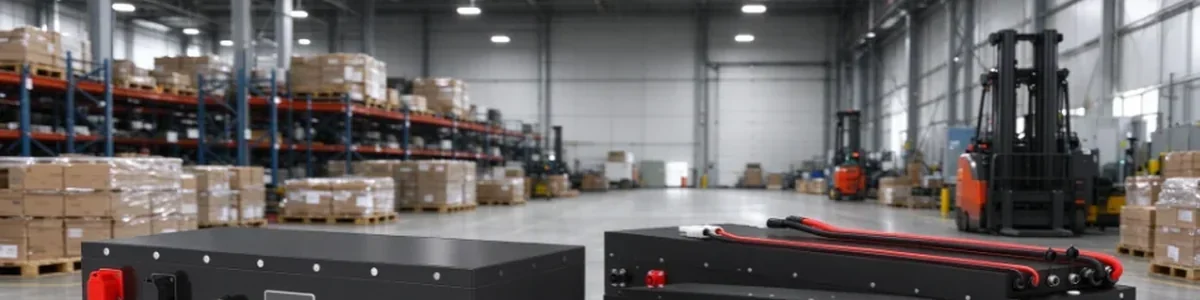
A port AGV runs almost continuously, charges in short windows at fixed points, and works in salt air and heat. It is the most demanding duty in this catalogue.
What the equipment needs
| Equipment | Voltage | Duty |
|---|---|---|
| Automated guided vehicle | 48 V / 80 V | Opportunity charging, 24 h |
| Terminal tractor | 80 V+ | Heavy continuous draw |
| Straddle / RTG | Higher voltage | Very large packs, different class |
How to size the pack
1. Cycle energy. An AGV moving a container across a terminal may use 2–5 kWh per loop, with a loop every 10–20 minutes.
2. Charge window. If it charges 8 minutes per loop, the pack only needs to cover one loop plus margin — which is why AGV packs are smaller than their daily energy suggests.
3. Heat derating. At 45 °C the continuous rating drops. Size on the derated figure, not the 25 °C datasheet.
Opportunity charging decides the chemistry
An AGV that charges for eight minutes between jobs needs a pack that accepts current immediately and does not care about partial state of charge. That is the property sodium brings, and it is why the chemistry appears in automated terminals.
Heat and salt
Coastal terminals run hot and humid. The pack needs a thermal path, and the enclosure needs corrosion-resistant hardware. Sodium’s wider ambient window reduces cooling demand but does not remove the need to design the enclosure.
Where it does not pay
Manual terminals. Shift-based battery swaps and low utilisation rarely justify the change.
Very small fleets. Under about ten vehicles, the charging infrastructure dominates the cost.
Questions buyers ask
Can it charge in 8 minutes?
The pack can accept it; the charger and the site supply usually cannot. Most terminals limit by the installed charging power.
What about the heat?
Derate the continuous rating. A pack sized at 25 °C will not deliver the same current at 45 °C.
Is it safe in a port environment?
With a sealed enclosure and marine-grade hardware. The risk assessment needs the test report, not the brochure.
How long does a pack last?
Use the cycle figure at your own depth and rate. Continuous shallow cycling is gentler than deep cycles.