


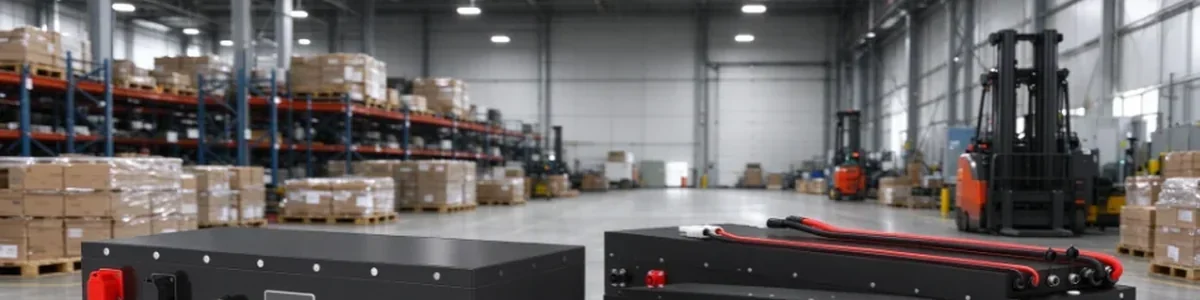
A warehouse robot does not have a duty cycle in the usual sense. It moves for ninety seconds, sits on a charge contact for forty, moves again — all day, all night, for years. That pattern is where a lead-acid block fails first and where sodium-ion is at its most comfortable.
What the duty actually looks like
Three numbers decide the pack: the voltage the drive and the lift motor want, the ampere-hours that cover one shift between charges, and the number of charge events per day. Everything else — chemistry, BMS, housing — follows from those.
| Robot type | Typical pack | Charge pattern |
|---|---|---|
| Shelf AMR (Kiva-style) | 24–48 V, 20–40 Ah | Opportunity charging at fixed contacts, 10–40 times per day |
| Shuttle cart | 24 V, 10–30 Ah | Rail contacts at the end of each aisle run |
| Sorting robot | 48 V, 20–50 Ah | Fast top-up between sort windows |
These are the ranges we see in enquiries, not a specification. A heavier lift or a faster traverse pushes the voltage up; a longer aisle pushes the capacity up.
Why shallow cycling suits sodium
A robot may complete twenty partial cycles a day. Over five years that is tens of thousands of charge events, almost none of them a full discharge. Sodium-ion cells tolerate that pattern without the lithium-plating risk that appears when a lithium pack is repeatedly topped up at high state of charge, and without the sulphation that ends a lead-acid block in this service.
The caveat is not the cell, it is the counter. A BMS that only counts full cycles will report a state of health that drifts away from reality within a year. Ask for a BMS that accumulates ampere-hours and tracks capacity fade across partial cycles, not one that simply counts discharges.
Contacts, dust and the 3 mm problem
Opportunity charging means exposed contacts in a dusty building. In our experience contact wear and dust ingress cause more field failures than cells do. Three design decisions prevent most of it: a contact geometry that wipes itself as the robot docks, a pack housing that keeps dust out of the terminal well (IP54 is usually enough inside a warehouse), and a serviceable contact block that can be replaced without opening the pack.
Where sodium is the wrong answer
If a small fleet runs one shift and batteries are swapped manually once a day, the duty is close to a single daily deep cycle, and a lithium pack of the same capacity will usually be smaller and lighter for the same money. Sodium pays back when the fleet is large, the charging is opportunistic and the pack has to survive a decade of partial cycles.
If the site is below −20 °C for weeks at a time, check the charge window before choosing: discharge is fine, but charging below that temperature needs either a heated pack or a charger that waits.
What we need to quote
- Drive voltage and the peak current the lift motor draws
- Shift length in hours, and the average and peak current draw
- Number of charge events per day, and whether charging happens at fixed contacts
- The bay the pack has to fit, including the contact block
- Fleet size and the annual volume you expect
Questions buyers ask
Can a sodium pack drop into a robot designed for lead-acid?
Mechanically yes, if the voltage window matches. Electrically the charger has to be reprogrammed: a sodium pack sits at a different absorption voltage, and the machine’s low-voltage cut-off usually needs raising so it does not read the pack as empty early.
How long does a 48 V 30 Ah pack last in two-shift operation?
That depends on depth of discharge and cell temperature, not on a headline cycle count. Send the duty cycle and we will size it against the ampere-hours the robot actually consumes per shift rather than against a catalogue figure.
Do you supply the charger too?
We specify the charge profile and can quote a charger with the pack. If you keep your existing charger, we need its model and its current settings before the order is frozen.