


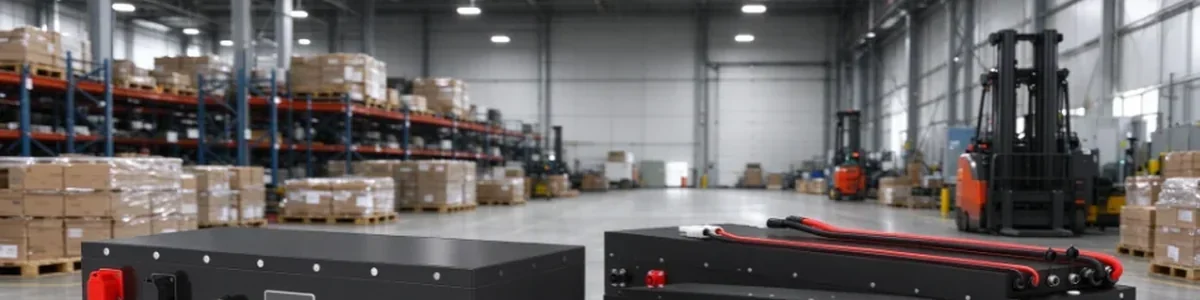
Two-wheelers, trikes and AGVs are the largest lead-acid replacement market in volume terms, and the swap is usually decided by four numbers rather than by chemistry.
The four numbers
Outside dimensions — the bay does not grow. Terminal position and polarity — a reversed terminal is a dead controller. Charge voltage window — the existing charger has to land inside it. Continuous current — the motor decides this, not the battery label.
Capacity in Ah is the least important of the four. A sodium pack discharges deeper without shortening life, so a smaller Ah figure can deliver more usable energy than the lead-acid block it replaces.
The charger question
Most 12 V and 24 V lead-acid chargers work if the absorption voltage stays inside the pack window; the BMS handles the top cut-off. What does not work is a charger with a desulphation pulse — it will trip the protection board.
For 48 V and 60 V scooters, the charger is usually matched to the pack anyway, and the swap ends up including it.
Where it stops being drop-in
When the continuous current exceeds about 1C, when the bay is shorter than the original block, or when the vehicle needs a communication protocol the old harness does not carry.
In those cases the answer is a custom pack with a different cell format, not a bigger version of the drop-in.
AGV: a different duty
An AGV charges in the gaps between tasks, many times a day, at partial depth. That is the duty sodium handles well — partial cycles at high rate without the memory effect that used to punish lead-acid.
Opportunity charging only works if the pack accepts it; check the charge rate at the ambient temperature of the warehouse before promising a 24-hour operation.
What the swap actually uses
Most two-wheeler conversions land on 10 Ah cells in a 32140 or 33140 format, 3.0 V nominal, charging to 4.0 V and discharging to 1.5 V. A 48 V pack is therefore 16S, not the 13S a lead-acid charger expects — the BMS has to enforce the top cut-off, because the old charger will not.
Where to go next
Questions we get asked about this
Will my existing charger work?
Usually for 12 V and 24 V if the absorption voltage sits inside the pack window. A desulphation pulse will trip the BMS.
Do I need to change the controller?
No, if the voltage window matches. A 48 V sodium pack and a 48 V lead-acid pack are not identical in range, so check the low-voltage cut-off.
Why does a smaller Ah pack last longer?
Because usable depth of discharge is higher. A 20 Ah sodium pack can deliver more usable energy than a 30 Ah lead-acid block.