


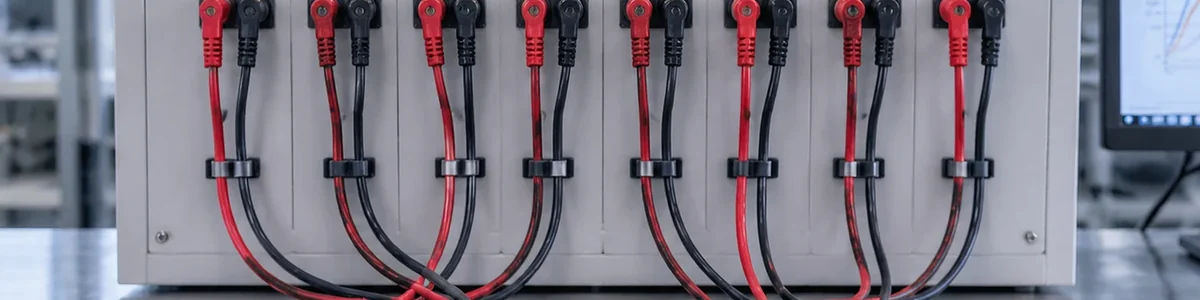
Abuse tests are how a chemistry is judged under conditions it was never designed for. For sodium-ion the headline is not “safe” — it is that the thermal runaway threshold tends to sit higher than NMC and comparable to or above LFP, depending on the cathode.
The four tests that matter
Nail penetration forces an internal short. The result to look for is whether the cell vents, smokes or ignites, and how the neighbouring cells respond in a pack test.
Crush simulates mechanical damage in a crash or a dropped module. Overcharge checks the BMS and cell tolerance together. External short is the most common real-world event and the one most often skipped in marketing sheets.
What the chemistry gives you
Hard-carbon anodes and sodium cathodes generally show a higher onset temperature for self-heating than NMC, and several published test series show no ignition under nail penetration on prismatic cells. That is a real advantage in a container or a basement — not a promise that a pack cannot burn.
LFP remains the reference for a chemistry with a high threshold and a long record. If your insurer or your fire engineer has already approved LFP, sodium is not automatically accepted; the test report is what convinces them.
What a test report should contain
Cell model and batch, test standard and revision, initial state of charge, ambient temperature, the measured result and the observation (vent, flame, temperature curve), and the lab that signed it. A one-line statement that a cell “passed” is not a report.
For a pack, the meaningful test is propagation: does one failed cell take the module with it? That is where enclosure design and spacing matter more than the cell datasheet.
Questions worth asking
Which standard was used — GB 38031, IEC 62619, UL 1973 or a customer-specific protocol? At what state of charge was the nail test run? Was the pack tested as a pack or extrapolated from cells?
If the answers are vague, the report is decoration. Ask for the document and read the observation column, not the conclusion.
Where to go next
- Quality and compliance documents
- Cells with published abuse-test results
- Talk to an engineer about pack-level testing
Questions we get asked about this
Are sodium batteries fireproof?
No chemistry is. Sodium cells generally show a higher thermal runaway onset than NMC and a threshold comparable to or above LFP, depending on the cathode — which lowers risk, not eliminates it.
Which test should I ask for first?
The nail penetration test at pack level, because it shows whether one failed cell propagates to its neighbours. Cell-level results do not answer that.
Do I need UL 9540A?
For a grid-connected storage system in North America, usually yes. For a vehicle pack, the applicable standards are different — GB 38031, IEC 62619 or ECE R100 depending on the market.