


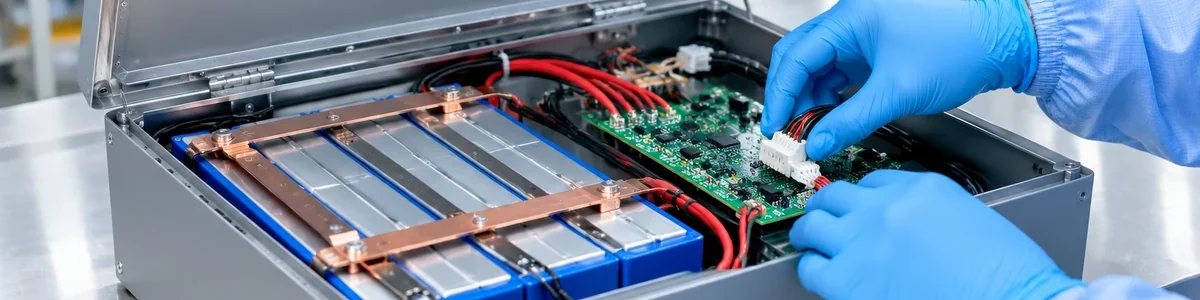
High-rate pouch cells are the least intuitive product in the sodium catalogue. A cell that can deliver 60C continuously exists because some applications need seconds of enormous current, not hours of moderate current.
What 60C actually means
At 60C a 5 Ah cell delivers 300 A. That is not a typo, and it is not sustained for minutes: the datasheet condition is usually a short window with a temperature limit attached, and the pack has to remove the heat that arrives in those seconds.
Pulse ratings of 100C and above are quoted for tens of seconds at most. Treat them as a peak the protection circuit must survive, not as an operating point.
Where it is worth paying for
Engine start-stop, hybrid boost, power tools, drone take-off, and any application where the mass of the pack is the constraint and the energy is small. In these products a 60C cell replaces two or three lower-rate cells in parallel.
The gain is package size, not efficiency. You are buying the ability to shrink the pack.
What it costs
Tabs and busbars carry hundreds of amps, so the weld quality becomes the reliability limit. The pack needs a current path designed as a conductor, not as a connector.
Thermal design stops being optional: the heat is generated in a thin foil stack, and if it cannot leave through the tabs and the faces, the cell derates itself or ages fast.
When not to buy it
If the load profile is a steady 1C for hours — a scooter, a storage cabinet, a golf cart — a high-rate cell is money spent on capability that never gets used, and often at the cost of energy density.
Rate is a tool for a specific duty. Ask for the temperature rise at your own pulse profile before choosing the cell that wins on the datasheet.
What high rate costs in cycle life
Our 18650 cells built for rate — 900 mAh at 20C, 850 mAh at 35C — are quoted for 1,000 cycles to 85% when tested at 1C and 25 ± 2 °C. A 0.5C cell of larger format reaches four times that. Rate capability and cycle life are bought from the same budget.
Where to go next
Questions we get asked about this
What does 150C pulse mean in practice?
A current 150 times the capacity for a few seconds, with a temperature limit attached. It is a peak the design must survive, not an operating point.
Why do high-rate cells cost more?
Thinner electrodes, wider tabs and tighter process control. You pay for current path, not for energy.
When is a high-rate cell a waste of money?
On any duty that sits near 1C for hours — a scooter, a storage cabinet, a golf cart.