


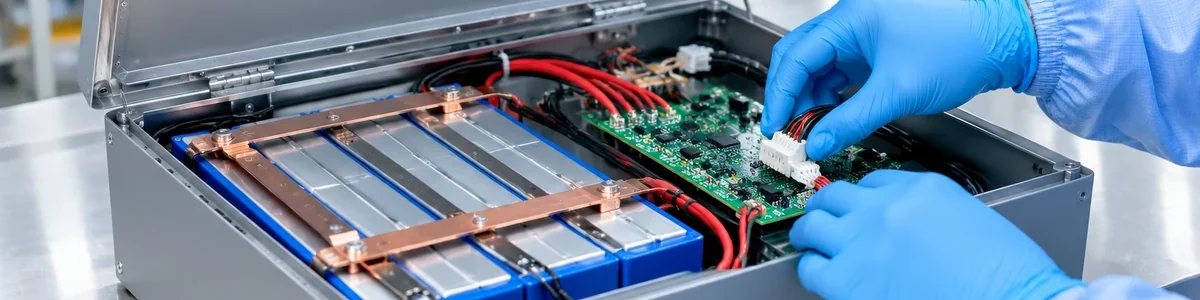
Three engineers describe the same problem — “we need about 5 kWh” — and end up with three different cells. Not because one is better, but because their constraints are different.
“My bay is 180 mm tall”
This one is a swap pack for a delivery scooter. The bay was designed around a lead-acid block and cannot grow. Prismatic cells stacked in two rows fit; the same energy as 32140 cylinders would need a taller holder stack and waste volume on the round-to-square gaps.
The trade-off is assembly: prismatic cells need compression hardware, and the stack has to hold preload over life. For a volume build that is a jig cost; for a prototype it is a weekend of brackets.
“It gets dropped”
This one is a portable power unit for a worksite. Cylindrical cells win here for mechanical robustness: the can takes the load, standard holders exist, and a spot-welded pack survives vibration that would crack a pouch tab.
The cost is packing density — up to 25% of the volume is air between round cells. On a product where mass is fine and durability is not, that trade is easy.
“It has to be 12 mm thick”
Pouch cells exist for the envelope nobody else can fill: thin, wide and light. They also give the best current path for high rate, because tabs can be wide and short.
The cost appears later: pouches need mechanical support in the pack, they swell slightly over life, and the tab weld is the usual failure point in a poorly designed stack.
What the comparison actually says
| Prismatic | Cylindrical | Pouch | |
|---|---|---|---|
| Volume efficiency | high | lower (round gaps) | highest |
| Mechanical robustness | good with compression | best | needs support |
| Assembly cost | medium | low, standard holders | high, tab welding |
| High-rate path | medium | medium | best |
| Typical use | storage, swap packs | light EV, tools | thin enclosures, high rate |
Pick by the constraint you cannot change — the bay, the drop test, or the thickness. Then check that the cell family in that format has the cycle life your duty needs.
What the three formats look like in the catalogue
The same product range covers 220 Ah in prismatic, 18 Ah in a 46145 cylindrical and 10 Ah in a pouch — same chemistry, three envelopes. The 220 Ah prismatic specifies a 3.95 V charge cut-off and a 1.50 V discharge cut-off; the 46145 reaches 3,000 cycles at 0.5C with a 4.0 V charge limit. Format decides the mechanics; the electrical window follows it.
Where to go next
Questions we get asked about this
Which format gives the most energy per litre?
Pouch, then prismatic. Cylindrical cells lose up to a quarter of the volume to the gaps between round cans.
Which survives vibration best?
Cylindrical. The can carries the mechanical load and standard holders exist, which is why tools and light EVs use them.
Can I mix formats in one pack?
Not in series. Different formats have different impedance and thermal behaviour, which makes balancing unpredictable.