


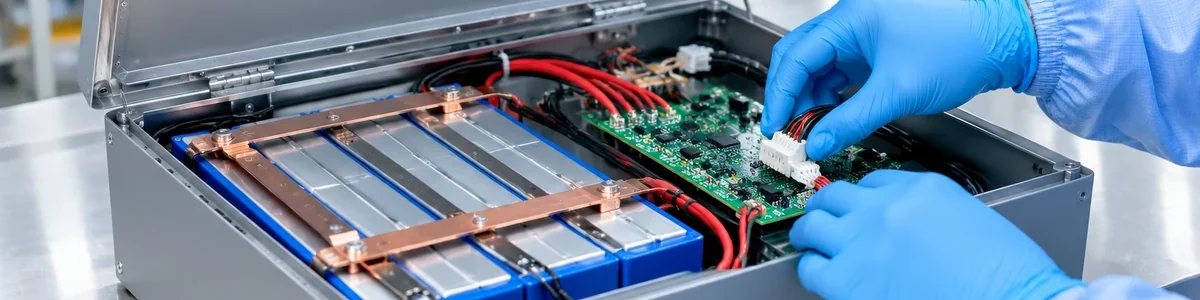
A large prismatic cell is not a small cell scaled up. From 50 Ah to 190 Ah, the module assembly changes in four places, and each one is a cost before it is an engineering problem.
Step 1: Handling
A 190 Ah cell weighs several kilograms and has a thin aluminium shell. Lifting it by the terminals bends them; lifting it by the body needs a fixture. That fixture is the first cost a large-cell design adds.
Below about 100 Ah, two people can build a prototype module. Above that, a jig and a hoist are the realistic answer, which puts a prototype out of reach for a small workshop.
Step 2: Busbar
Current does not scale with capacity, it scales with the load. The busbar is sized by continuous current and by the heat it can dump, and a larger cell usually means fewer parallel strings, so each joint carries more current.
Laser welding needs a clean, flat contact face; bolted joints need torque control and a re-torque interval. On a 190 Ah module, one bad joint becomes a hot spot that the BMS may not see until it is expensive.
Step 3: Preload
Prismatic cells swell and contract during cycling. The stack needs compression that stays inside a window over thousands of cycles — typically a few hundred kilograms of force per cell face, with end plates and tie rods sized for it, not a strap.
This is also where the cycle-life claim in the datasheet comes from. A stack that loses preload in year two will not reproduce the number, and nothing in the BMS will tell you why the capacity drifted.
Step 4: Thermal
Large cells have more thermal mass and worse surface-to-volume ratio. Heat generated in the middle of a 190 Ah cell has further to travel, so the cooling path has to be designed rather than assumed.
For slow cycling in a temperate site, natural convection through a gap may be enough. For 1C continuous, a cold plate is not optional.
Choosing a capacity
Fewer, larger cells mean fewer welds, fewer sense wires and less assembly labour — but a single-cell fault takes a bigger share of the pack, and handling costs jump above 100 Ah.
The usual sweet spot for a custom pack is 100–160 Ah: enough to keep the part count down, small enough to build without a hoist.
Where the numbers sit at each size
At 55 Ah a prismatic cell is quoted for 4,000 cycles at 0.5C. At 220 Ah the same family specifies 0.50C standard charge to 3.95 V, 0.50C discharge to 1.50 V, and a cold-charge limit of 0.20C between −30 °C and 0 °C. The bigger cell does not gain cycle life — it trades it for fewer parts and a harder thermal problem.
Where to go next
Questions we get asked about this
What is the largest prismatic sodium cell available?
Around 190 Ah in current commercial ranges, with 280–314 Ah appearing on the roadmap. Larger cells reduce part count but raise handling and thermal difficulty.
Do large cells need more compression?
The force per unit area stays similar; the total force rises with area, so the end plates and tie rods must be sized for it.
Is a 190 Ah cell better than two 100 Ah cells?
Not automatically. Fewer welds and sense wires help; a single failure takes a larger share of the pack, and handling needs a fixture.