


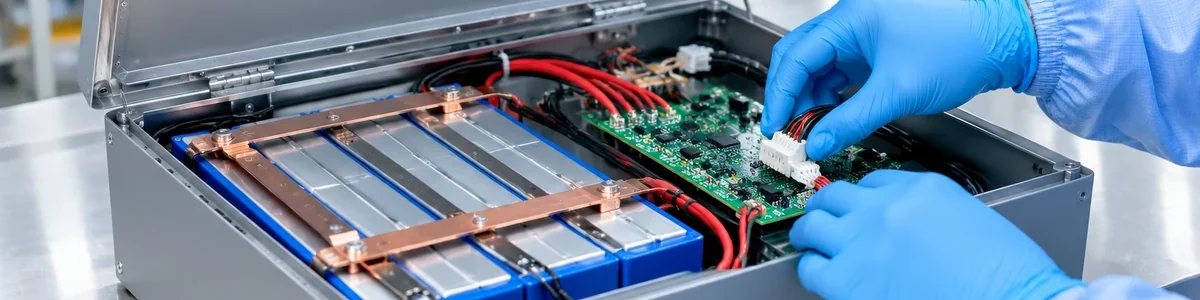
Custom pack projects fail on missing inputs, not on engineering. Factories can build what is described; delays come from what was not described until week six.
Week 0: what to send
Envelope with mounting points, continuous and peak current, voltage window, temperature range, target market and certification scope, quantity for the first three orders, and any fixed connector or protocol.
A drawing beats a paragraph. A photograph of the bay with a ruler in it beats both.
Week 1–2: cell and BMS
Format follows the envelope and the current; chemistry follows temperature and duty; the BMS follows the cell curve and load profile.
This is the cheapest moment to change a specification. After tooling starts it is expensive.
Week 3–6: prototype
One or two units built to the drawing, tested at the specified current and temperature. Expect the first prototype to expose one mechanical interference and one thermal assumption.
Prototype lead time from existing tooling is commonly 10–15 days.
Week 7–12: validation
Cycle, abuse and transport tests. Certification goes to a lab, and the lab calendar drives the schedule — budget four to eight weeks for a slot.
Schedules slip on changes after tooling, on unclear certification scope, and on quantities that never firm up. Fix the quantity band before the prototype.
What a build actually draws on
A custom pack in the 10–20 kWh range typically uses 32140 cells at 10 Ah or a 220 Ah prismatic for larger systems. The 220 Ah format specifies 0.50C charge to 3.95 V and a cold-charge limit of 0.20C below 0 °C, which feeds straight into the charger specification your customer will receive.
Where to go next
Questions we get asked about this
How long does a custom pack take?
A prototype from existing tooling is commonly 10–15 days; a new enclosure plus certification is three to four months.
Can you work to our drawings?
Yes. Drawings stay confidential and are not shared outside the build.