


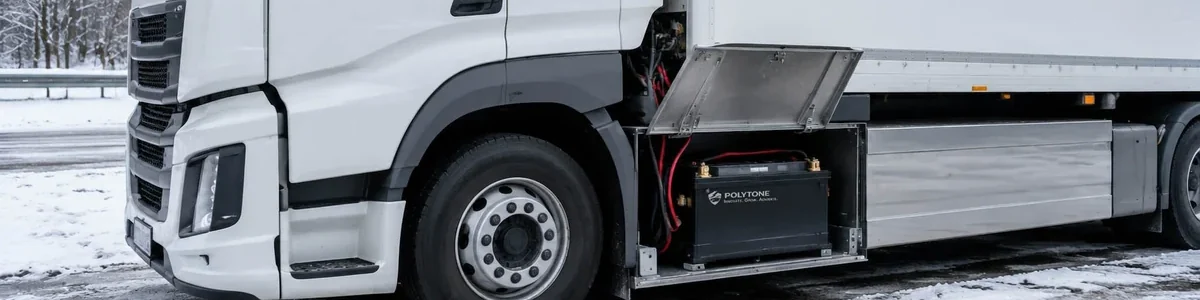
A tail lift is a peak-load machine. The pump draws a heavy current for ten to twenty seconds, the platform rises, and then the pack sits idle until the next stop. Sizing it by capacity alone is the usual mistake: what decides whether it works is the current the pack can deliver at the end of a shift, when it is cold and half empty.
What the lift actually draws
A 500–750 kg column lift on a 12 V or 24 V system typically pulls 150–350 A during the up stroke, and much less on the down stroke, which is gravity-assisted. The number that matters for the pack is the current at the end of the up stroke, at the lowest state of charge and the lowest temperature the vehicle will see.
| Lift class | System | Peak current, up stroke |
|---|---|---|
| 500 kg column lift, light van | 12 V | 150–200 A |
| 750 kg column lift, 3.5 t van | 12 V | 220–300 A |
| 1,000–1,500 kg cantilever, truck | 24 V | 250–350 A |
Those are field ranges, not a specification. The lift manufacturer publishes the motor rating, and that is the figure to size against.
Hundreds of lifts, shallow discharges
A busy multi-drop route can run forty to eighty lifts a day. Each one takes a few percent of the pack, so the pack rarely goes below 60% state of charge and rarely gets a full cycle. That is a hard life for a lead-acid block, which sulphates when it is never fully recharged, and an easy one for sodium.
The cut-off setting matters more than the capacity
Most lift controllers are set for a lead-acid voltage curve. Fit a sodium pack and the controller will read it as empty while it still has usable energy, then refuse to lift. Raising the low-voltage cut-off is part of the installation, not an optional tweak — and it has to be done before the vehicle goes back on the road, or the driver will report a pack that “cuts out under load”.
Where sodium does not fit
If the truck only does two or three lifts a day and the lift is fed from the vehicle battery, the pack is not the constraint and the standard battery is cheaper. Sodium pays back on multi-drop routes with high lift counts and on vehicles that stand for long periods between jobs.
What we need to quote
- Lift model, rated load and motor voltage
- Peak current from the lift manufacturer, and the duty per day
- Whether the lift has its own battery or shares the vehicle battery
- The tray the pack has to sit in, and how it is held down
- The coldest temperature the vehicle operates in
Questions buyers ask
Will a sodium pack crank the vehicle as well as run the lift?
It can, if the pack is sized for the cranking current as well as the lift. That usually means a larger pack than a lift-only installation, and a BMS with a separate cranking path. Tell us if you want dual use.
Can the lift charger be reused?
Only if its profile can be changed. A charger fixed at a lead-acid absorption voltage will undercharge a sodium pack and shorten its life. We ask for the charger model before quoting.
What about the platform dropping when the pack is empty?
That is a controller setting, not a battery one. The lift must have a documented low-voltage behaviour; we can supply the pack but we do not change the controller logic.