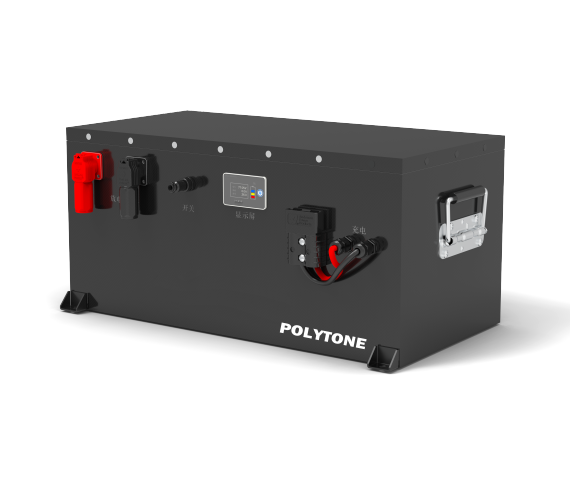
TP-A976 25.6 V 165 Ah battery — AGV and handling trolley
Brand: Polytone
Part number: TP-A976
Nominal voltage: 25.6 V
Nominal capacity: 165 Ah
Maximum continuous discharge current: 120 A
Cycle life: 2,500 (25 °C, 0.5C, 80% DoD)
Availability: In stock
Price on request — quoted per configuration, quantity and Incoterm.Ask for a price →
TP-A976 — a 25.6 V 165 Ah pack for automated guided vehicles and handling trolleys. 4.22 kWh, 3.07 kW of load and 150 A for 30 seconds in a 34 kg IP65 case.
Efficient power
Highly stable performance — no need to worry about performance degradation.
Fast charging, no memory effect, charge at any time.
Lighter weight, easier to manoeuvre and faster to start.
Safety and reliability
Completely sealed design, IP65 — waterproof and dustproof.
Intelligent BMS with balanced charging and multiple protections.
Stronger thermal and chemical stability, reducing the risk of thermal runaway.
Durable
Six-year design life, 2,500 (25 °C, 0.5C, 80% DoD).
Low self-discharge rate.
Manufactured to vehicle-grade production standards.
Maintenance-free
No gas or acid leakage, and no additional space required for batteries.
No need for frequent, time-consuming replacement.
Save labour and maintenance costs, lower total cost of ownership.
Declaration of conformity and warranty statement are issued with the order. Ask for the current revision if your design is already frozen.
Specification
TP-A976 25.6 V 165 Ah battery — AGV and handling trolley — specification
Chemistry
Prismatic cell pack (IFP48173166-165Ah)
Nominal voltage
25.6 V
Nominal capacity
165 Ah
Rated energy
4,224 Wh (4.2 kWh)
Maximum charging voltage
29.2 V
Maximum charging current
50 A
Maximum continuous discharge current
120 A
Maximum peak discharge current (30 s)
150 A
Maximum load power
3,072 W
Discharge cut-off voltage
20 V
Cell model
IFP48173166-165Ah
Cell brand
Anchi
Cell configuration
8S1P
Cycle life
2,500 (25 °C, 0.5C, 80% DoD)
Protection class
IP65
Overall dimensions
497.8 × 247 × 235.5 mm ±2 mm
Reference weight
about 34 ±0.5 kg
Application areas
AGV, moving trolley
Charging temperature
0 to +55 °C
Discharge temperature
−20 to +60 °C
Communication mode
Not specified
Ordering: MOQ and lead time
These figures are quoted by order type rather than per part number, because the same cell can ship from stock or start a new tooling project. If your quantity sits between two rows, the smaller one applies until a change is needed.
Minimum order quantity
Sample evaluation
1 unitA single piece, so you can test the chemistry and the fit before committing to a batch.
Standard catalogue item
5–10 unitsThe stocked line: cells, cases and components that need no change before shipping.
New ODM design
100–200 setsNew structure, new BMS protocol or new housing tooling. The batch size covers the setup work.
Large project
quoted per projectContainer-scale and framework agreements are quoted against the schedule, not against a unit price.
Production lead time
Stock item
3–5 working daysShipped from stock once the order is confirmed.
OEM (silk print, label, packaging only)
15–20 working daysSame structure and same BMS. Only the marking and the packaging change.
New ODM (new structure, BMS protocol, housing, diesel-to-electric)
30–35 working daysCounted from specification freeze, not from the enquiry.
Adding a certification
+15–30 daysOn top of the production time above. The laboratory sets the schedule, not us.
Shipping transit is quoted separately and starts after production finishes. We do not publish a transit figure, because it depends on the forwarder, the route and the season — ask for it with the order and we will quote the current rate.
Questions buyers ask
What voltage and capacity does this come in?
25.6 V nominal, 165 Ah capacity. The figures are the ones on the specification table on this page, not a range across the family.
What are the dimensions?
497.8 × 247 × 235.5 mm ±2 mm. Check the mounting space against this figure rather than against the catalogue photo, because the enclosure adds wall thickness on every side.
What temperature range does it operate in?
−20 to +60 °C. That is the discharge window. Charging has its own limits, given as −20 to +60 °C on this page, and the BMS thresholds have to match the cell data rather than a generic default.
What cycle life is quoted?
2,500 (25 °C, 0.5C, 80% DoD). A cycle figure only means something with its rate, temperature and end-of-life criterion, which is why we quote the condition next to the number instead of a bare count.
What continuous current can it take?
120 A. Size the cable and the busbar to this current with margin, and check that the BMS in your build is rated at least as high.
We use one first-party cookie to remember your language and consent choices. No advertising or cross-site tracking is loaded unless you accept analytics. Read the privacy notice.
 All batteries
 Sodium-ion cylindrical cells
 Sodium-ion prismatic cells
 Sodium-ion pouch cells
Compare all cells →